Information Asymmetry Strategist
Diagnose and resolve information asymmetry in strategic interactions using four mechanisms: signaling, screening, signal jamming, and countersignaling. Use this skill when a user needs to credibly communicate private information to an uninformed counterpart; when a user needs to elicit honest information from a better-informed counterpart without being able to verify their claims; when a user suspects they are on the receiving end of signal jamming or adverse selection and wants to see through it; when a user is designing a pricing scheme, contract structure, hiring process, or product menu and needs to induce self-selection among different customer or candidate types; when a user wants to know whether to signal their quality, countersignal by staying silent, or jam an opponent's signals; when a user needs to apply Bayes' rule to update beliefs after observing an opponent's action in a mixed-strategy game; when a user faces Akerlof-style market collapse risk and wants to identify signaling or screening remedies; when a user is designing a menu of options (e.g., airline fare classes, insurance deductibles, product tiers) and needs to check participation constraints and incentive compatibility constraints. This skill handles both directions of information asymmetry: the informed party communicating outward (signaling, countersignaling, jamming) and the uninformed party extracting information inward (screening, adverse selection management). It does NOT cover moral hazard or principal-agent problems after a contract is signed, nor does it handle simultaneous-move games without information asymmetry (use the Nash equilibrium skill for those).
 View on ClawhHub
Install
What You'll Need
Skill Relationships
Unlocks
Requires
No prerequisites. This is a foundation skill.
Source Book
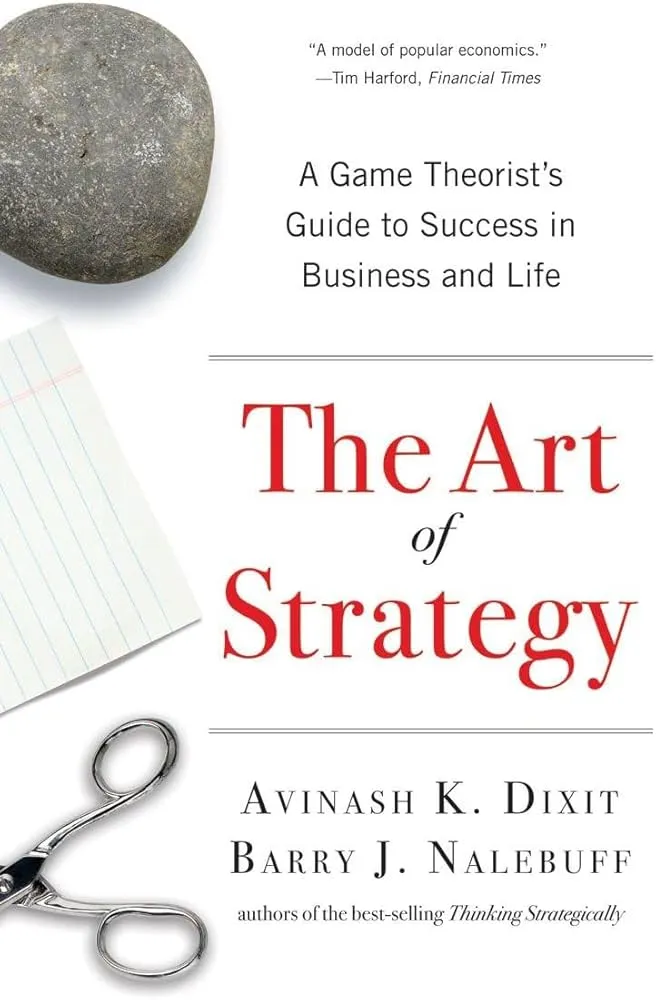
The Art of Strategy
Avinash K. Dixit & Barry J. Nalebuff